Which kitchen worktop to choose: thickness, edge, cut-outs
Published on 9 March 2020 · Updated on 31 October 2026
In short: at Prowest, choosing a kitchen worktop happens in two stages. First the material: composite quartz offers the widest choice of colours and edge profiles, while sintered ceramic withstands heat and sunlight. Then come five fabrication decisions: slab thickness, edge profile, sink and hob cut-outs, wall cladding and the position of the joints. These are discussed at the consultation, and the final dimensions are set at the site survey, once the kitchen units are installed.
The material first, in brief
The material determines how the worktop behaves with heat, sunlight and impact. Composite quartz does not tolerate hot pans placed directly on it and is not recommended in direct, prolonged sunlight; sintered ceramic, including Neolith and Laminam, has edges that are more sensitive to knocks. The differences are explained in the comparison quartz or ceramic: which worktop to choose.
The Prowest catalogue lists 210 models of quartz kitchen worktops, from 157,50 €/lm + VAT (1.019 lei/lm incl. VAT), and 46 models in ceramic, from 206,25 €/lm + VAT (1.334 lei/lm incl. VAT; prices shown in November 2026).

Slab thickness
Slab thickness is the actual thickness of the material the worktop is cut from. Quartz worktops are generally made from 2 cm slabs, and some models also from 1.5 cm slabs; the slab catalogue also lists 3 cm slabs for some models. Ceramic and Neolith worktops are listed at 1.2 cm.
The visible edge can be thicker than the slab: by bonding a strip of the same material underneath, the edge reaches an apparent thickness of 3, 4 or 6 cm without the whole worktop being thicker. On ceramic, the 1.2 cm edge can be visually thickened or finished with a vertical apron.
| Slab | Material | Catalogue price |
|---|---|---|
| 1.2 cm | Material: sintered ceramic and Neolith; slim profile, more sensitive edges | Ceramic: from 206,25 €/lm + VAT (1.334 lei/lm incl. VAT), median 250,80 €/lm + VAT (1.622 lei/lm incl. VAT) |
| 1.5 cm | Material: quartz, 19 models in the catalogue (Belenco, Calisco and Stone Italiana) | Quartz 1.5 cm: from 167,90 €/lm + VAT (1.086 lei/lm incl. VAT), median 208,25 €/lm + VAT (1.347 lei/lm incl. VAT) |
| 2 cm | Material: quartz, the standard thickness | Quartz 2 cm: from 157,50 €/lm + VAT (1.019 lei/lm incl. VAT), median 238,50 €/lm + VAT (1.543 lei/lm incl. VAT) |
On models offered in both thicknesses, the 2 cm version usually costs more. For example, Calisco 2101 Admira quartz costs 167,90 €/lm (1.086 lei/lm incl. VAT) at 1.5 cm and 227,85 €/lm (1.474 lei/lm incl. VAT) at 2 cm, excluding VAT. Across different models, however, the manufacturer and the colour matter more than the thickness, so a fair comparison is made on the same model.
The edge profile
The edge is the visible side of the worktop. Prowest produces 15 edge profiles, from the classic straight edge to special and premium profiles such as Ogee or Dupont. Edges are shaped and polished with water in our own workshop.
- Classic straight, at slab thickness: the simplest option; it suits plain, flat fronts.
- Classic, thickened to 4 cm: gives the worktop more presence without a thicker slab.
- Premium profiles (Ogee, Dupont): rounded or moulded edges that suit classic-style kitchens.
Elaborate profiles are made mainly in quartz, whose body is coloured through its full thickness. On ceramic, the edge is usually straight, thickened by bonding or finished with a vertical apron. Use matters too: a slightly rounded edge is less prone to chipping than a perfectly sharp one, especially on ceramic.
Cut-outs for the sink, hob and tap
Worktops made and installed by Prowest come with all cut-outs already made. The important decision is how the sink and the hob are fitted.
| Element | Options | What changes |
|---|---|---|
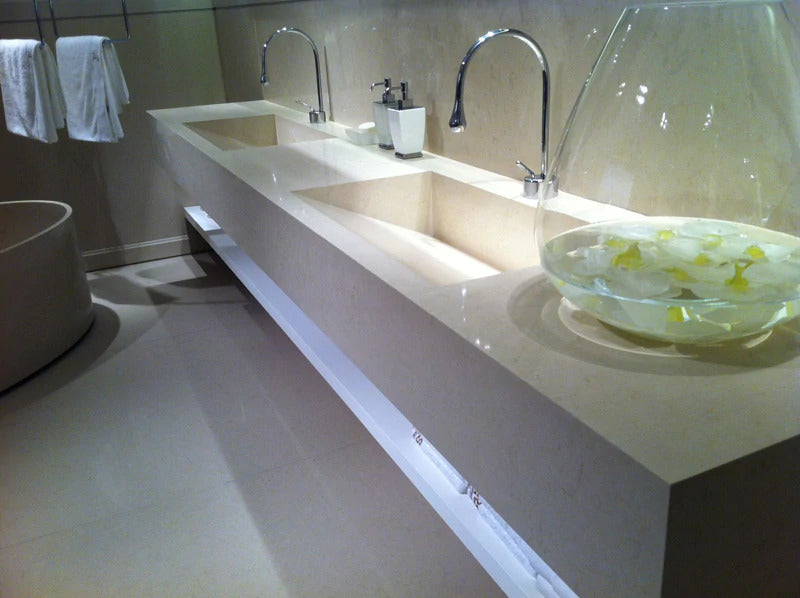
| Sink | Options: inset (top-mounted); undermounted; made from the same material and bonded seamlessly to the worktop. | Effect: for an undermounted sink, the cut-out edge is profiled and polished with water, and Prowest fits the sink in the workshop; there is no rim for dirt to collect on. |
| Hob | Options: mounted on top of the worktop or, on quartz, flush with the worktop. | Effect: a flush hob leaves a flat surface that is easy to wipe. |
| Tap and soap dispenser | Options: holes in the worktop, positioned at the site survey. | Effect: the position is coordinated with the sink and the wall. |
| Sockets | Options: sockets built into the worktop. | Effect: keeps the wall clear. |
For accurate cut-outs, choose the sink, hob and tap models before the site survey, because each cut-out is made to their dimensions.
Wall cladding and upstands
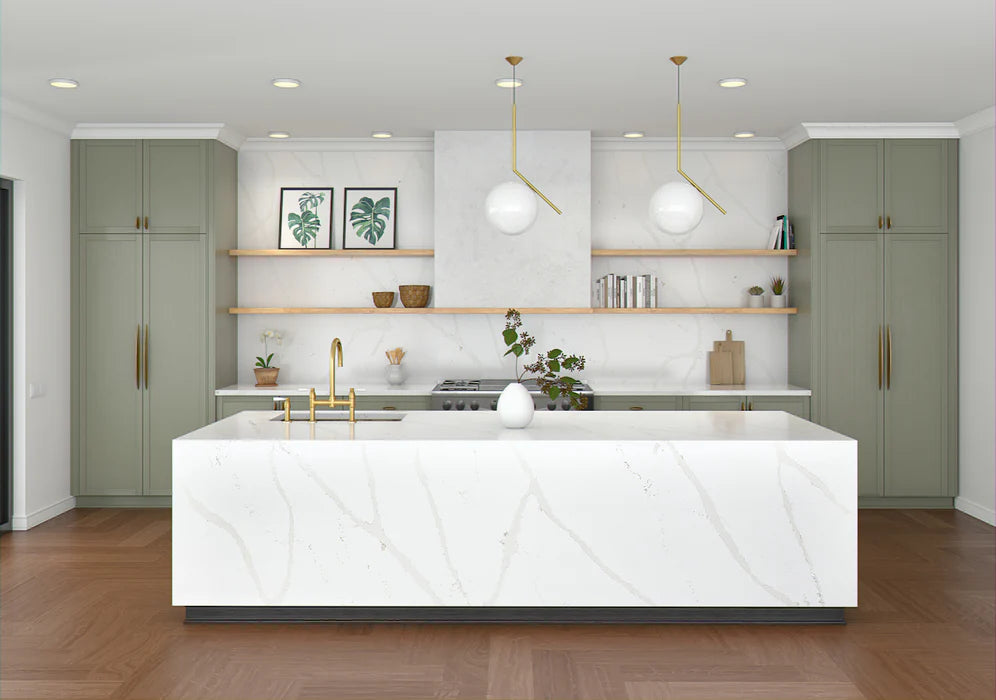
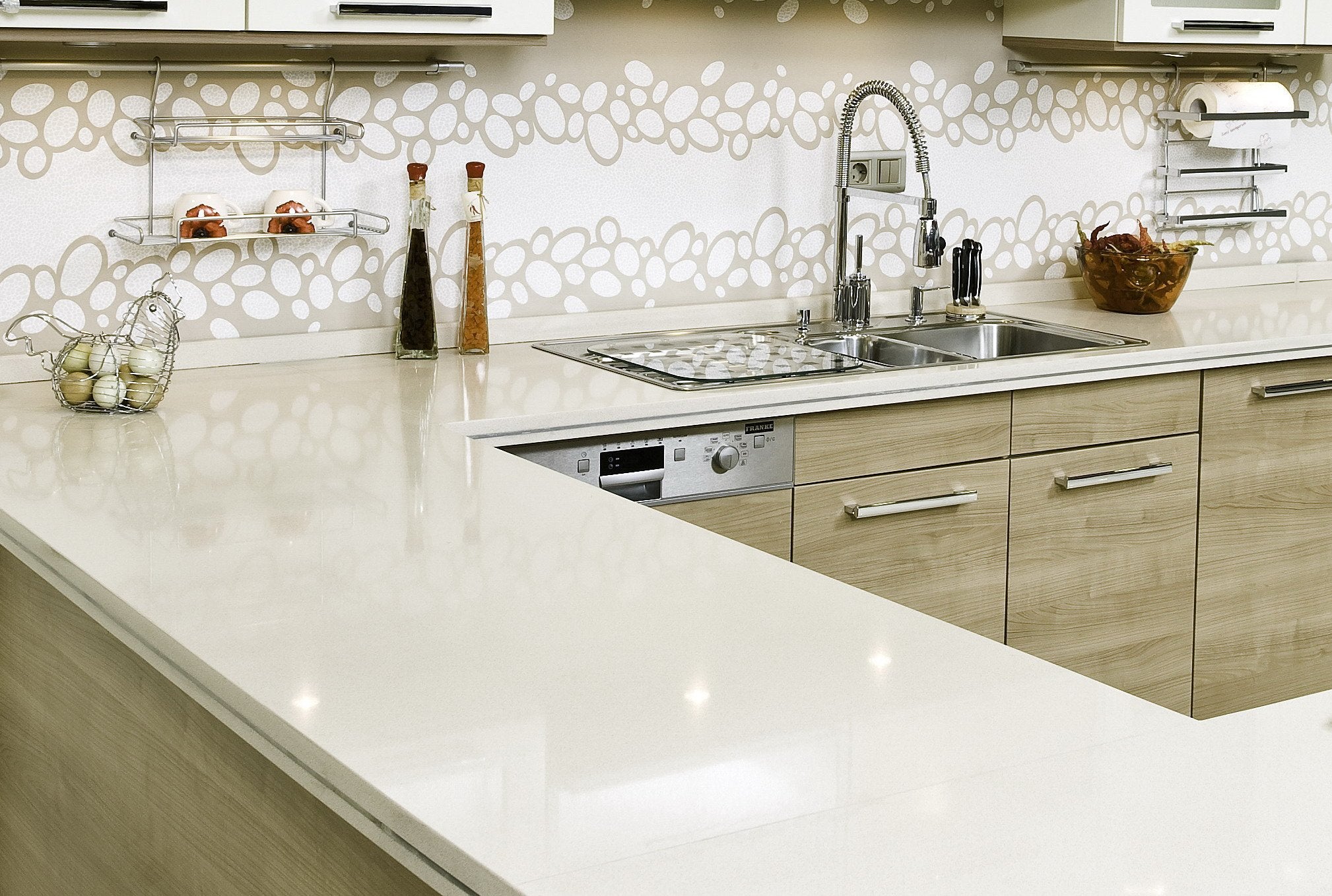
The wall between the base units and the wall units can be clad in the same material as the worktop. Cladding has no tile grout lines, is cleaned like the worktop and can continue its pattern. The usual options are an upstand along the wall, which is 4 cm high in many Prowest projects, cladding between the units, and full-height wall cladding, as in the project with a worktop and cladding in black Marquina-style quartz.
If you choose quartz cladding, the hob position matters: at least 5–7 cm must remain between the edge of the hob and the cladding when the large burner faces the wall, otherwise the heat can damage the cladding over time. In that case the worktop needs to be deeper, at least 65 cm, which should be agreed early with the kitchen designer.
Joints: where they appear and how they are hidden
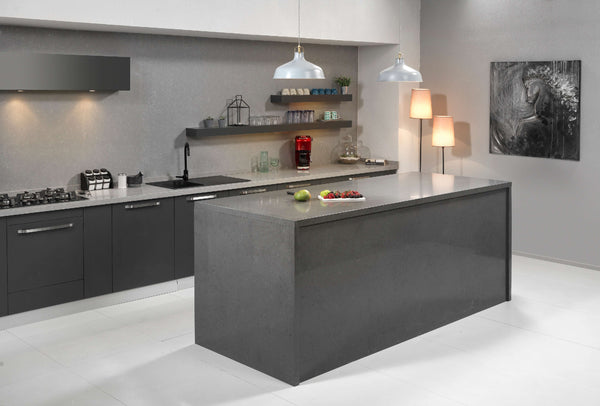
A worktop is cut from slabs of fixed size. In the Prowest catalogue, quartz slabs are typically between 305 × 140 and 330 × 165 cm, and ceramic slabs between 320 × 160 and 324 × 163 cm. A straight worktop shorter than the slab can be made in a single piece. An L-shaped or U-shaped worktop, a very long run or a large island is made from several pieces, and therefore has joints.
On stone worktops, including quartz, joints are visible; how visible depends on the accuracy of the survey, the fabrication and the installation. That is why their position is set at the site survey, so that they are as discreet as possible. On strongly veined models the pattern does not continue perfectly across a joint; on solid-colour or fine-grained models a joint is harder to spot.
Colour and finish, chosen together with the fronts
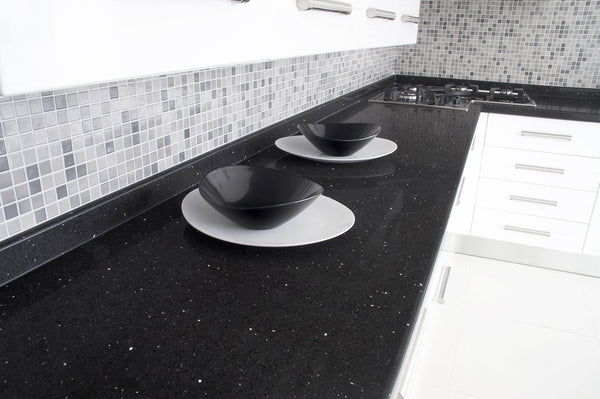
- Finish: almost all quartz worktops in the catalogue are polished (203 models out of 210). In ceramic, 29 models come in a matt version, and many of them can be ordered in either matt or polished.
- Colour: fine scratches show more easily on dark polished surfaces; on any worktop, always cut on a chopping board.
When the site survey takes place
The material, colour, edge and layout are chosen at the consultation, in the showroom, by phone or together with your architect. The final measurements are taken on site, after the kitchen units are installed, once:
- the units are in their final position and will not be moved;
- the surrounding walls are fully finished;
- plumbing and electrics are in place;
- the client or an authorised person is present.
The survey fixes the exact width, the positions of the cut-outs and the location of the joints; the worktop is then made in our own workshop at Str. Doina 9, Bucharest, and installed by the Prowest team.
Summary: decisions and their effect on price
| Decision | Options | Effect on price |
|---|---|---|
| Material | Options: quartz, ceramic, Neolith, Laminam | Price: quartz from 157,50 €/lm (1.019 lei/lm incl. VAT), ceramic from 206,25 €/lm, excluding VAT (1.334 lei/lm incl. VAT) |
| Thickness | Options: 1.2, 1.5 or 2 cm | Price: on the same model, the thicker slab usually costs more |
| Edge | Options: classic straight, thickened, special and premium profiles | Price: special profiles and thickened edges are priced separately in the quote |
| Cut-outs | Options: inset, undermounted or same-material sink; top-mounted or flush hob; tap, sockets | Price: each cut-out is included in the quote |
| Cladding | Options: upstand, cladding between units, full-height cladding | Price: priced separately from the main worktop |
| Piece width | Options: standard worktop, peninsula, island | Price: wider pieces use more material, so they cost more per metre |
Worked examples based on real projects are in the guide how much a metre of kitchen worktop costs. The prices in this article are those shown on the website in November 2026, excluding VAT, and may include current promotions; the valid price is the one on the product page.
Prices in lei include 21% VAT, at the NBR exchange rate of 11.11.2026 (€1 = 5,3460 lei).
Frequently asked questions
Can I choose the worktop before the kitchen units are installed?
Yes. At Prowest, the material, colour, edge and layout are chosen at the consultation, including in the showroom. The final measurements, however, are taken after the units are installed, because the worktop is made to the actual position of the units and walls.
Do I need an upstand if I am not cladding the wall?
An upstand covers the gap between the worktop and the wall, where water and crumbs would otherwise collect, so without cladding it is the usual choice. It is made from the same material as the worktop; in many Prowest projects it is 4 cm high.
What thickness should I choose for a quartz worktop?
The standard thickness is 2 cm. The 1.5 cm slab is available only on some models in the Prowest catalogue and gives a slimmer profile. If you want a thicker-looking edge, you do not need a thicker slab: the edge can be built up to 4 cm by bonding a strip of the same material.
For a quote based on your kitchen layout, write to us through the contact page or visit the showroom at Str. Doina 9, Bucharest.