
Useful information
Quartz worktops: what they are, pros, cons and care
A Prowest quartz worktop, fabricated to order in the company's own Bucharest workshop, is made of composite quartz, a manufactured material of crushed natural quartz bound with polyester resins and pigments. It is non-porous, resists stains and scratches well and cleans with a damp cloth, but it cannot take hot pans placed directly on it and is not recommended outdoors. It is not natural stone but a composite.
What composite quartz is
Composite quartz, also called engineered quartz, composite stone or, in the trade, a composite worktop, is a manufactured material. The quartz in it is natural, but the finished slab is not stone cut from a quarry: the crushed crystals are bound by resin and the pigments give the colour. Some models also contain crushed mirror, glass or mother-of-pearl for decorative effect.
Proportions vary between manufacturers and between series: the Technistone data sheet gives, by product group, 84.5–92% mineral components (silica sand, quartz, glass, crushed mirror or granite, depending on the group), 7.5–14% resin and at most 1.7% pigments, by weight.
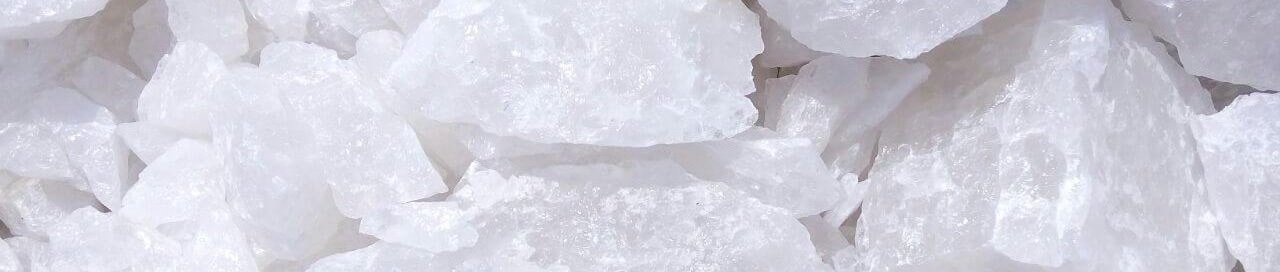
Quartz crystals have a hardness of 7 on the Mohs scale. Diamond has 10, and the scale is not linear, so the claim that quartz is "almost as hard as diamond" is wrong. The worktop resists scratches well, but it is not indestructible.
How it is made
The mix of quartz, resin and pigments is compacted by vibration under vacuum and pressure, then cured, calibrated and polished into large sheets called slabs. From these slabs Prowest makes the worktop in its own workshop at 9 Doina Street, Bucharest, by cutting, making the cut-outs and water polishing. The steps are described in detail in the article Quartz slabs: what they are and how they are made.
How a quartz worktop performs
| Property | Composite quartz |
|---|---|
| Pores and stains | Pores and stains: non-porous. The water absorption declared by the manufacturers is 0.05% for Stone Italiana and Calisco and 0.01–0.07% for Technistone (EN 14617-1). It needs no sealing. Clean stains while they are fresh; left for more than 24 hours, they may leave marks. |
| Scratches | Scratches: resistant, but cutting directly on the worktop can leave fine scratches, most visible on dark glossy surfaces. |
| Heat | Heat: tolerates only short exposure to moderate temperatures, up to 100–120 °C. The thermal shock from a hot pan or tray can cause cracks, discolouration or loss of gloss. |
| Sun and outdoor use | Sun and outdoor use: not recommended. UV radiation can discolour the resin; Cimstone and Stone Italiana advise keeping slabs out of direct sunlight even in storage. |
| Impacts on edges | Impacts on edges: more forgiving than ceramic. Chips on the edge can usually be repaired, sometimes with visible marks. |
| Thickness | Thickness: worktops are generally made from 2 cm slabs, and some models also from 1.5 cm slabs. Some models are also available as 3 cm slabs, to order. The visible edge can reach 3, 4 or 6 cm by joining a strip of the same material. |
| Slab size | Slab size: in the Prowest catalogue, quartz slabs range from 305 × 140 cm to 330 × 165 cm, depending on the manufacturer. Larger worktops and islands are made from several pieces. |
| Appearance | Appearance: a uniform, predictable pattern from slab to slab; between production batches there are only minor differences in shade. On veined models, the pattern does not continue perfectly across a joint. |
Advantages and disadvantages
Advantages
Non-porous. Liquids do not penetrate the material, so the worktop needs no varnish or sealing and cleans with a damp cloth and liquid detergent.
Many models and finishes. The catalogue has 210 models of quartz kitchen worktops: solid colours, granular, with mirror flecks or with a marble pattern, mostly glossy, some matte or textured.
Predictable pattern. Unlike granite or marble, the slab you receive looks like the sample, with small differences in shade between batches.
A wide choice of edge profiles. The material is coloured through its full thickness, so the edge can be profiled. Prowest makes 15 types of edge profile, including an edge thickened to 4 cm by joining and water polishing.
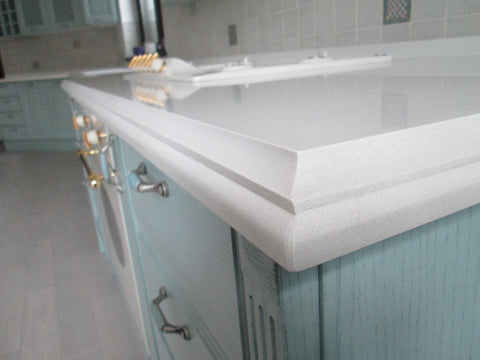
Complete fabrication. Cut-outs can be made for the hob, sink, tap and built-in sockets, as well as an undermount sink, a quartz sink joined seamlessly to the worktop and wall cladding in the same material.
Disadvantages
Sensitive to heat. Always put hot pans on a trivet. This is the main difference from ceramic.
Not for outdoor use. On terraces, in outdoor kitchens or in direct, prolonged sunlight, the resin can discolour.
Visible joints. Long worktops, L-shaped worktops and islands larger than a slab have joints. How visible they are depends on the precision of the measuring, fabrication and installation.
Limited repairs. A scratched surface is much harder to restore than marble, which can be re-polished. Chips on the edge can usually be repaired, but marks sometimes remain.
Price. A quartz worktop costs more than one made of melamine-faced chipboard or HPL laminate, but it stands up much better to water, scratches and acidic substances in the kitchen.
Quartz compared with other materials
Compared with sintered ceramic, including Neolith and Laminam, quartz copes less well with heat and sunlight, but it tolerates impacts on the edges better and allows more edge profiles. Compared with granite, quartz is non-porous and needs no periodic sealing, whereas granite handles heat better and can be used outdoors. The differences, criterion by criterion, are in the full comparison of quartz, ceramic, Neolith, Laminam and granite.
Care and use
A quartz worktop needs no periodic treatment, only a few simple rules.
| Situation | What to do |
|---|---|
| Daily cleaning | Daily cleaning: a damp cloth and liquid detergent, then rinse with water so that no residue dries on the surface. |
| Dried stains | Dried stains: the soft side of a sponge and a spray cleaner; scrape stubborn stains gently with a plastic spatula, then rinse. |
| Products to avoid | Products to avoid: bleach, aggressive high-pH cleaners (for ovens, grills or dishwashers), abrasive or oil-based products, and solvents (thinners, paint strippers). |
| Hot pans | Hot pans: always on a trivet, never directly on the worktop. |
| Cutting | Cutting: use a chopping board; also avoid repeatedly sliding objects with rough bases across the surface. |
| Furniture and installations | Furniture and installations: do not stand on the worktop and do not move the cabinets or their legs; a worktop left unsupported in places can crack and its joints can come apart. |
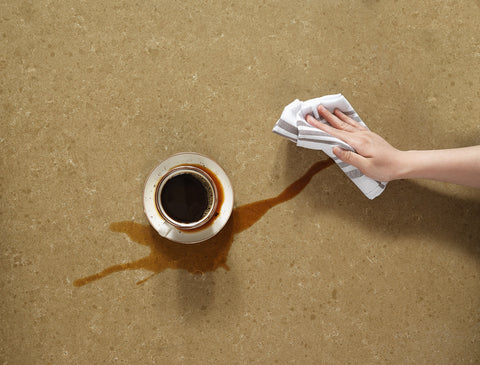
The full list, by type of soiling, is in the care and use instructions for quartz worktops, and the solutions for coffee, wine, oil or limescale are in the article on stains on quartz worktops.
Brands and ranges
The Prowest catalogue has quartz worktops from Belenco, Calisco, Cimstone, Stone Italiana and Technistone, grouped into the Eco, Medium, Premium and Exclusive ranges. All of them are composite quartz; they differ in pattern, finish, available thicknesses and price, and the differences are explained in the guide on how to choose a quartz brand and range.
How much a quartz worktop costs
In the Prowest catalogue, a quartz kitchen worktop costs from 157,50 €/lm + VAT (1.019 lei/lm incl. VAT; 190,58 €/lm including VAT) up to 360 €/lm + VAT (2.329 lei/lm incl. VAT), with a median price of 237,55 €/lm + VAT (1.537 lei/lm incl. VAT). These are the prices shown on prowest.ro and may include current promotions. At Prowest, quartz bathroom worktops start at 105 €/lm + VAT (679 lei/lm incl. VAT), and quartz slabs at 95 €/m² + VAT (615 lei/m² incl. VAT). Prices updated: November 2026.
The final price depends on the length and width of the pieces, the edge, the cut-outs, transport and installation. See the made-to-order quartz kitchen worktops, the quartz bathroom worktops and the worked examples in the price guide.
Frequently asked questions
The questions below are about the material. Answers about ordering, measuring and installation are on the Frequently asked questions page.
Is quartz the same as the mineral quartz?
Quartz is a natural mineral, silicon dioxide, and the name is also used in the trade for composite quartz. A quartz worktop contains crushed natural quartz, but it is not a slab of quartz: it is a composite in which resin binds the crystals, which gives it both its advantages and its limits compared with natural stone.
What do "composite stone" and "composite granite" mean?
"Composite quartz", "engineered quartz" and "composite stone" all describe the same type of material. "Composite granite" is a misleading name: even if some models imitate granite or contain crushed granite in the mix, the slab is a resin-bound composite and behaves like quartz, not like granite, especially with heat and sunlight.
Is quartz suitable for contact with food?
The surface is non-porous and easy to clean, so it is widely used in kitchens. Food-contact certifications are issued by the manufacturers, per product: the Technistone data sheet mentions NSF for selected products, Calisco states that only products bearing the NSF mark are NSF certified, and Stone Italiana declares overall migration values under UNI EN 1186. Ask for the technical data sheet of the model you choose.
How long does a quartz worktop last?
Prowest estimates an average service life of more than 25 years when the instructions for use are followed; this is an estimate, not a guarantee, and the commercial warranty is 2 years. Worktops are damaged mainly by hot pans, heavy knocks on the corners and furniture shifting underneath, not by normal wear.
Can the wall behind the hob be clad in quartz?
Yes, with enough clearance from the hob. Prowest recommends at least 5–7 cm between the edge of the hob and the wall cladding when the large burner is on the wall side; this means the units must allow a deeper worktop, at least 65 cm, which should be agreed with the kitchen designer. The Cimstone application guide requires at least 6 cm between the hob and the wall cladding and 10 cm on each side, plus a heat-insulating strip around the hob cut-out.
Warranty
Prowest provides a 2-year commercial warranty for composite quartz worktops and islands made by Prowest. The warranty requires the care and use instructions to be followed, is valid with the tax invoice and the signed acceptance report, and does not extend to silicone, sealants or adhesives. The commercial warranty does not affect consumers' statutory rights regarding the conformity of goods (Romanian Government Emergency Ordinance No. 140/2021). The full terms are on the Warranty page.
Samples can be seen in the Prowest showrooms at 9 Doina Street, Sector 5, and at Expo Top Construct, 23 Valea Cascadelor, stand B4–B5, Bucharest. For measuring and installation in Bucharest and Ilfov, see the page on quartz worktops in Bucharest (in Romanian); for a recommendation for your project, contact us.
Prices in lei include 21% VAT, at the NBR exchange rate of 11.11.2026 (€1 = 5,3460 lei).
Do you want to see the material in person or do you need a price?