
Useful information
Ceramic worktops (sintered ceramic): pros and cons
A Prowest ceramic worktop, fabricated to order in the company's own Bucharest workshop, is made of sintered (porcelain) ceramic: large slabs of natural minerals, pressed and fired at over 1,200 °C, with no resins. It resists heat, scratches and sunlight, does not absorb liquids and can also be used outdoors. On the other hand, its edges and corners are more sensitive to impacts than those of quartz.
What sintered ceramic is
Sintered ceramic for worktops is produced in large-format slabs from natural minerals (clay, feldspar, quartz) and pigments, pressed at very high pressure and fired at over 1,200 °C. Firing partially melts and fuses the particles, so the material needs no resins or other organic binders. This is the source of its main qualities: it does not burn, does not fade in sunlight and does not absorb liquids.
The terms "sintered ceramic", "porcelain ceramic" (large-format porcelain stoneware) and "sintered stone" refer to the same family of materials. Technically, EKXTRA slabs, for example, are porcelain stoneware under EN 14411, group BIa, with water absorption of no more than 0.5%. Neolith (a brand of the Spanish manufacturer TheSize) and Laminam (an Italian manufacturer) belong to the same family; other brands exist on the market, such as Dekton, which is not in the Prowest catalogue.
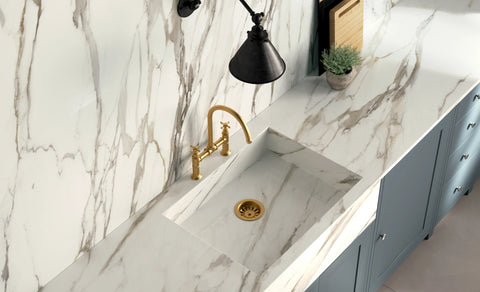
A ceramic worktop is not a worktop covered with tiles: it is cut from a large slab, 1.2 cm thick in the Prowest catalogue, and joints appear only where the worktop is larger than the slab. The pattern (marble, stone, concrete, metal, wood) is printed digitally, usually on the surface; on many models, the body of the slab is a different colour from the face.
How a ceramic worktop performs
| Property | Sintered ceramic |
|---|---|
| Heat | Heat: contains no resins that could burn. Fondovalle reports, in CATAS tests, no visible effect from dry heat up to 200 °C (EN 12722), and EKXTRA reports resistance to thermal shock. |
| Sun and outdoor use | Sun and outdoor use: stable under UV radiation and frost-resistant, so it also suits outdoor kitchens and terraces. |
| Stains and chemicals | Stains and chemicals: does not absorb liquids and needs no sealing. It resists acids, alkalis and solvents; the only product EKXTRA advises against is hydrofluoric acid. |
| Scratches | Scratches: highly resistant. On the glossy lappato finish, scratch resistance is lower, EKXTRA notes. |
| Impacts on edges | Impacts on edges: edges and corners are more sensitive than on quartz, and a chip is hard to repair without a trace. For this reason the top edges are chamfered; Fondovalle requires a chamfer of at least 2 mm. |
| Thickness | Thickness: 1.2 cm for the worktops in the catalogue. The edge can be thickened visually to 2.4 or 4 cm by joining, or finished with a vertical apron. |
| Slab size | Slab size: in the Prowest catalogue, ceramic slabs range from 320 × 160 cm to 324 × 163 cm. |
Advantages and disadvantages
Advantages
Tolerates heat. With no resins in it, ceramic copes with a hot pan or tray much better than quartz. A trivet is still advisable for very hot cookware, such as trays straight from the oven, and it protects the finish from rough pan bases.
Works outdoors. It is stable in sunlight and frost, so it can be fitted in outdoor kitchens, on terraces or in rooms with strong sunlight through the windows.
Resists stains and needs no treatment. It does not absorb liquids, needs no sealing and tolerates most household cleaners, including limescale removers.
Large slabs and continuous cladding. The worktop, wall cladding and island can be made from the same slab, with the pattern running from one surface to the next and fewer joints.
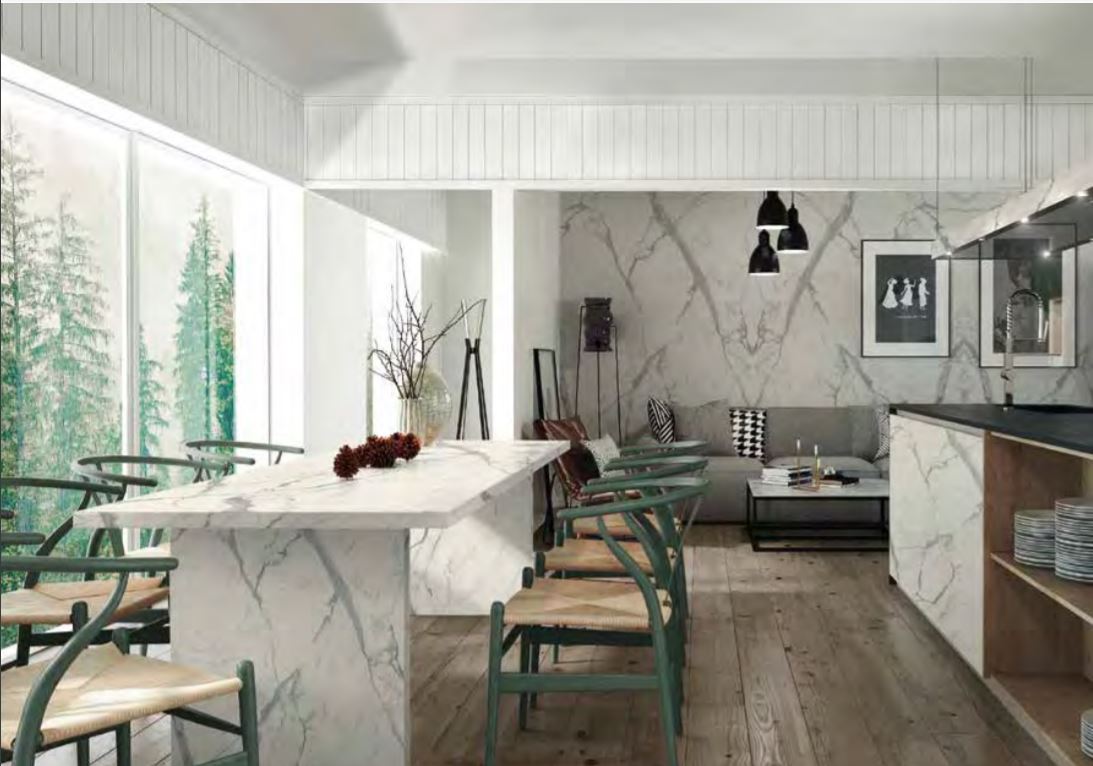
Slim profile. At 1.2 cm, the worktop has a slim profile that suits modern kitchens; for a heavier look, the edge is thickened by joining.
Disadvantages
Sensitive edges. A hard knock from a heavy object on an edge or corner can chip the slab; the EKXTRA manual warns that strong impacts can even break the material. Rounded or chamfered corners reduce the risk.
Repairs are hard to hide. A chip can be filled, but the mark usually stays visible, especially on models whose body is a different colour.
Fewer edge profiles. The edge is usually straight or thickened by joining, because the body of the slab may differ in colour from the face; the classic rounded profiles available on quartz are limited.
Demanding fabrication. Cut-outs are made with diamond tools, with rounded inside corners and minimum distances from the edges, as the manufacturers require. Fabrication and installation matter as much as the material.
Matte or glossy finish
Many ceramic worktops in the catalogue come in both a glossy and a matte finish, each with its own price. For example, Fondovalle Calacatta Gold costs 259,60 €/lm + VAT (1.679 lei/lm incl. VAT) in the glossy version and 285 €/lm + VAT (1.844 lei/lm incl. VAT) in the matte version (prices shown in November 2026, which may include current promotions). The practical differences between the finishes, in fingerprints, scratches and cleaning, are explained in the article on matte or glossy ceramic for worktops.
Ceramic or quartz?
Ceramic copes with heat and sunlight much better than quartz. Quartz, on the other hand, tolerates impacts on the edges better and allows more edge profiles. If you cook a lot or have an outdoor kitchen, ceramic is usually the better choice; if you want a profiled edge or are worried about knocks on the edges, quartz. The criteria, one by one, are in the comparison of quartz, ceramic, Neolith, Laminam and granite.
Ceramic worktops for outdoor and summer kitchens
Sintered ceramic, including Neolith and Laminam, is the material in the catalogue suited to outdoor use: EKXTRA and Fondovalle state that it resists UV, frost and prolonged humidity, and Fondovalle even allows the slabs to be stored outdoors. Outdoors, what sits under the worktop matters too: the cabinets or frame must also be suitable for outdoor use, stable and perfectly level, and an undermount sink must rest on support bars fixed inside the cabinet, not on the worktop alone.
Care and use
Sintered ceramic needs no sealing and no special products. A few simple rules keep the finish looking new.
| Situation | What to do |
|---|---|
| Daily cleaning | Daily cleaning: warm water and a neutral detergent, then rinse and wipe with a clean cloth so that no limescale marks remain. |
| Wine, coffee, lemon | Wine, coffee, lemon: leave no permanent marks if wiped off promptly; on the glossy lappato finish, remove them immediately. |
| Grease | Grease: an ordinary kitchen degreaser, then rinse thoroughly. |
| Limescale and rust | Limescale and rust: household limescale or rust removers, used as directed on the label, then rinse with clean water. |
| Products to avoid | Products to avoid: hydrofluoric acid; products containing wax or oils, which leave a film; abrasive sponges and powders on glossy finishes. Wipe bleach off the glossy lappato finish immediately. |
| Hot pans | Hot pans: the material copes with heat much better than quartz; for trays straight from the oven and to protect the finish, still use a trivet. |
| Cutting | Cutting: use a chopping board, for the sake of both the surface and your knives. |
| Impacts | Impacts: avoid knocking heavy objects against the edges and corners. |
Prices at a glance
| Material | Models | From | Median | Up to |
|---|---|---|---|---|
| Ceramic, kitchen worktop | 46 models | from 206,25 €/lm + VAT (1.334 lei/lm incl. VAT) | median 250,80 €/lm + VAT (1.622 lei/lm incl. VAT) | up to 285 €/lm + VAT (1.844 lei/lm incl. VAT) |
| Neolith, kitchen worktop | 64 models | from 325,60 €/lm + VAT (2.106 lei/lm incl. VAT) | median 445,50 €/lm + VAT (2.882 lei/lm incl. VAT) | up to 553,35 €/lm + VAT (3.579 lei/lm incl. VAT) |
| Laminam, kitchen worktop | 59 models | from 286 €/lm + VAT (1.850 lei/lm incl. VAT) | median 334,80 €/lm + VAT (2.166 lei/lm incl. VAT) | up to 389,50 €/lm + VAT (2.520 lei/lm incl. VAT) |
Prowest prices are in euros per linear metre, excluding VAT, calculated on the models with a price shown on prowest.ro in November 2026, and may include current promotions; including VAT, the lowest ceramic price becomes 249,56 €/lm (1.334 lei/lm incl. VAT). The ceramic kitchen worktops in the catalogue are from EKXTRA, Fondovalle and Nuovocorso. See all the sintered ceramic kitchen worktops, and for the other brands, the About Neolith and About Laminam pages.
Ceramic is also used for bathroom worktops, from 150,15 €/lm + VAT (971 lei/lm incl. VAT), and for cladding or fabrication there are ceramic slabs, priced per square metre.
Frequently asked questions
Answers about ordering, measuring and installation are on the Frequently asked questions page; the questions here are about the material.
Are sintered ceramic, porcelain ceramic and sintered stone the same thing?
In practice, yes: all are slabs made from natural minerals pressed and fired at high temperature, without resins. The trade names and each manufacturer's recipes differ. Neolith usually uses the term "sintered stone", while Italian ceramic slab manufacturers speak of large-format porcelain stoneware; the basic properties are the same.
Can a sink be mounted under a ceramic worktop?
Yes. At Prowest, the cut-out is made in the workshop with diamond tools, with rounded inside corners and a chamfered top edge, as the manufacturers require. The sink must rest on support bars fixed inside the cabinet, not on the worktop alone. Manufacturers such as Fondovalle also provide for integrated sinks made from the same slab.
Can I cut food directly on a ceramic worktop?
The surface is highly scratch-resistant, but cutting directly on it blunts knives quickly, and scratch resistance is lower on the glossy lappato finish. Use a chopping board; it protects both your knives and the look of the surface, especially on glossy finishes.
Is a ceramic worktop suitable for contact with food?
Yes. The surface is non-porous, and the manufacturers declare it suitable for food contact: EKXTRA states that food substances do not alter the ceramic surface, and Fondovalle publishes CATAS tests for overall migration (UNI EN 1186) and hygiene. Ordinary cleaning with a neutral detergent is enough.
Warranty
Prowest provides a 2-year commercial warranty for ceramic worktops and islands made by Prowest. The warranty requires the care and use instructions to be followed, is valid with the tax invoice and the signed acceptance report, and does not extend to silicone, sealants or adhesives. The commercial warranty does not affect consumers' statutory rights regarding the conformity of goods (Romanian Government Emergency Ordinance No. 140/2021). The full terms are on the Warranty page.
The ceramic slabs can be seen in the Prowest showrooms at 9 Doina Street, Sector 5, and at Expo Top Construct, 23 Valea Cascadelor, stand B4–B5, Bucharest. For a recommendation for your project, contact us.
Prices in lei include 21% VAT, at the NBR exchange rate of 11.11.2026 (€1 = 5,3460 lei).
Do you want to see the material in person or do you need a price?