
Care and Use Instructions
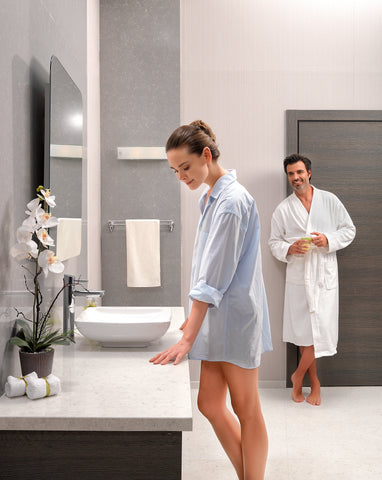
Quartz kitchen worktops are renowned for their remarkable durability over time. The average lifespan of a quartz worktop is over 25 years. The product will maintain its natural shine and elegance, even after many years of use, if you follow a few simple maintenance rules.
Maintenance of the quartz worktop
To ensure your worktop remains in the best condition for many years to come, please pay attention to a few simple rules for maintaining this product:
- You can maintain its natural shine and elegance with a simple routine cleaning (damp cloth and liquid detergent).
- It is always easier to clean a fresh stain than to deal with dried dirt. Therefore, try to remove fresh traces of food, coffee, juices, etc. before they turn into dried stains. Always rinse thoroughly with plenty of water to remove all traces of cleaning agents used.
Cleaning the quartz worktop
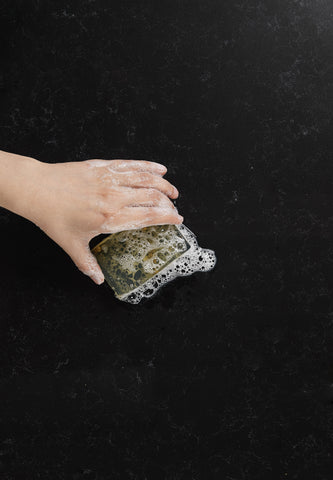
The composite quartz worktop can be cleaned very easily, being resistant to stains and scratches. It is enough to wipe it with a damp cloth and liquid detergent. Always make sure that after cleaning you have removed detergent traces with water and do not let detergent residues dry.
What cleaning products you can use, depending on the type of dirt:
- Spilled liquids: a damp cloth and a liquid detergent, if necessary. Rinse with water and dry.
- Dried liquids (juices, sauces, coffee, tea, etc.): A damp cloth or cotton rag and a Scotch Brite / 3M sponge plus a spray detergent (Cif Power Spray / Mr Muscle Kitchen Spray). Rub with the cloth or the soft side of the sponge, then rinse well with water and wipe dry.
- Grease: A damp cloth and Ajax Spray or Mr Muscle Kitchen Spray. Apply to the stain, remove the stain, then rinse thoroughly with plenty of water and wipe the surface.
- Hard-to-remove dried stains (mustard, chewing gum, paint, nail polish): A plastic spatula, damp cloth and Mr Proper Active Gel or Domestos. Apply to the stain, gently scrape with the spatula and remove the stain, then rinse thoroughly with plenty of water and wipe the surface.
- Rust or limescale: Cilit Bang Anti Calcar or Marc Deo Lime and Rust Removing Gel. Apply directly to the stain, remove the dirt, then rinse thoroughly with clean water.
Important: it is recommended to clean liquid and/or food stains when they are still fresh. Do not let long periods of time (over 24 hours) pass from their appearance, otherwise you may encounter difficulties in their complete removal, with the possibility of small permanent marks/stains remaining. Also, do not let the quartz worktop surface dry without thoroughly cleaning detergent residues or cleaning agents. Avoid at all costs using cleaning agents containing bleach (these can irreparably damage the worktop surface).
Conclusion: quartz surfaces are stain-resistant provided that traces of liquids or food are removed while they are still fresh.
Substances / chemical products to avoid when cleaning or maintaining the quartz worktop:
- Aggressive cleaning agents with a high pH level (oven or grill detergents, dishwasher detergents)
- Cleaning substances containing bleach
- Cleaning products containing oils, powders, or abrasive substances (such as oil soaps, furniture cleaning substances, abrasive detergents - tix, etc.)
- Alkaline products containing active hydroxide (disinfectant products)
- Products containing aliphatic or aromatic solvents (thinners or paint removers)
- All acidic substances that are strong enough to affect grouts (sealant at joints)
In case of accidental contact with such substances, immediately wash the worktop and rinse thoroughly with plenty of water to neutralize the effect.
Using the quartz worktop
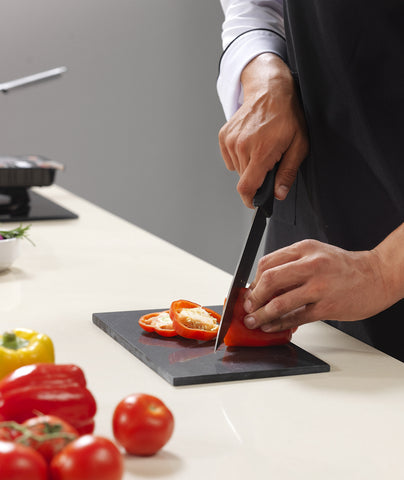
- Although the composite quartz worktop is scratch-resistant, cutting directly on its surface can result in very fine scratch marks, especially on dark-colored surfaces with a glossy finish. Therefore, to maintain an impeccable surface and a new appearance, we recommend always using a cutting board.
Also, avoid repeatedly rubbing objects (bottles, jars, pots, etc.) on the worktop surface, especially those with uneven or ribbed bottoms. In these cases, we recommend using supports or mats on which to place these objects, especially when using the dishwasher. - The quartz kitchen worktop is heat-resistant, meaning it can tolerate short-term exposures to moderate temperatures (up to 100-120 degrees Celsius). However, like any other stone surface, it can be damaged by sudden temperature changes, i.e., by thermal shocks. Therefore, we strongly recommend to absolutely avoid placing hot pots or trays directly on the worktop, as there is a risk that its surface may be irreparably damaged (cracks or loss of gloss in the affected area).
- If you opt for wall cladding with a quartz slab, special attention must be paid to the positioning of the hob relative to the wall, specifically the distance remaining between the edge of the hob and the wall slab. This distance must be min 5-7 cm, if the hob has the 'large burner' positioned towards the wall. Otherwise, the wall slab can be damaged over time by the heat/flames emanating from the large burner of the hob. Therefore, this aspect must be considered together with the furniture designer, who must ensure that the furniture installation allows for an increased worktop depth/width (min 65 cm). We do not assume responsibility for the damage to the quartz wall slab in this case.
- Over time, the structure of certain furniture units (their legs) may give way or suffer minor changes in flatness, so please periodically check that the worktop does not remain suspended/stressed in certain areas compared to others, even by a few millimeters.
- We recommend that any repair performed on kitchen furniture, appliances, or existing installations in the respective area be done carefully to avoid changes, even minor ones, in the position of furniture units (or other structures) which may result in the displacement of certain worktop pieces, their tensioning, or the deterioration of the joints between them. In this case, ensure that the worktop maintains continuous and uniform contact with the furniture units, without any areas where it remains suspended, even by a few millimeters.
- During furniture cleaning operations, as well as windows and sills positioned in areas adjacent to the worktop, we recommend that you absolutely avoid climbing on the kitchen worktop!
These things, individually or cumulatively, can lead to tensioning of the worktop with possible subsequent cracking in certain sensitive areas, or the detachment of the adhesive (sealant) from the joint area between pieces or between the worktop and plinth/riser.
As you can see, it is enough to take these recommendations into account to enjoy not only the easy maintenance and cleaning of your Prowest worktop, but especially the shine and new appearance of your kitchen worktop for the next 10-20 years.