Kitchen worktop trends in 2026
Published on 30 October 2024 · Updated on 31 October 2026
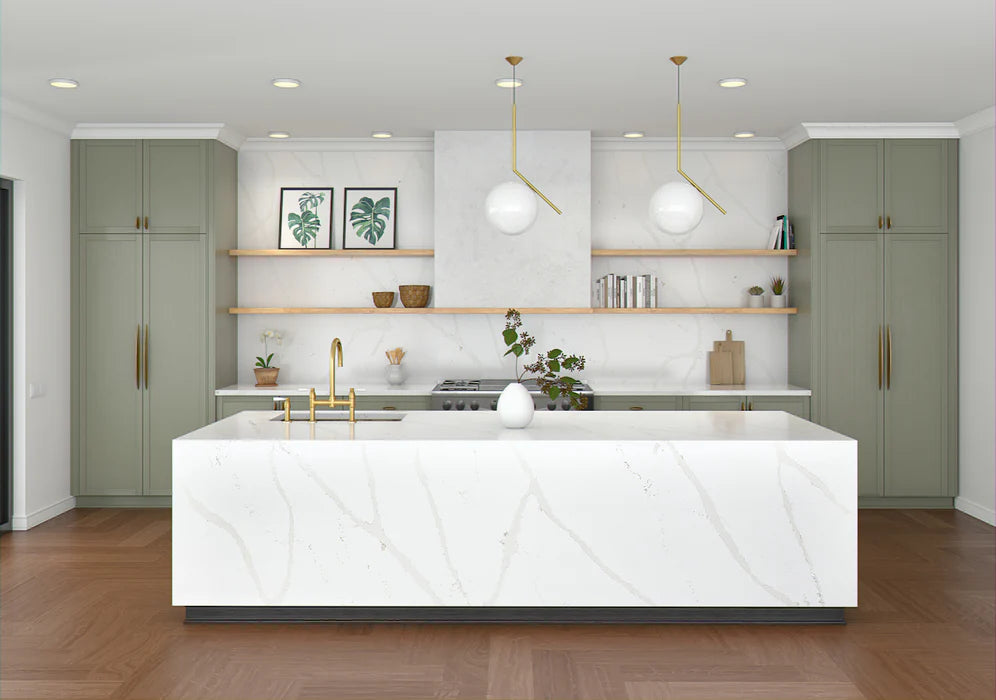
In 2026, the Prowest catalogue shows a few clear directions in kitchen worktops: the marble look is the most widespread, matt finishes are available on many ceramic models, and stone, travertine, concrete or wood looks are found mainly in ceramic. In the portfolio projects, the same material often continues onto the wall, the island and the sink, and sintered ceramic is the material used for outdoor kitchens.
The conclusions below are based on the Prowest catalogue and on the portfolio projects, not on predictions. The figures update automatically with the catalogue.
1. The marble look, the most widespread
Of the 210 models in the quartz kitchen worktop range, 100 have a marble look, and 56 are Calacatta-type, with a white background and bold veining (a model can carry both labels). In the ceramic worktop category, 25 of 46 models have a marble look; Neolith and Laminam have their own categories.
The reason is practical: natural marble is porous and softer, and it stains and scratches more easily, whereas composite quartz and sintered ceramic have no pores and need no sealing. You keep the look without the maintenance that natural stone requires.
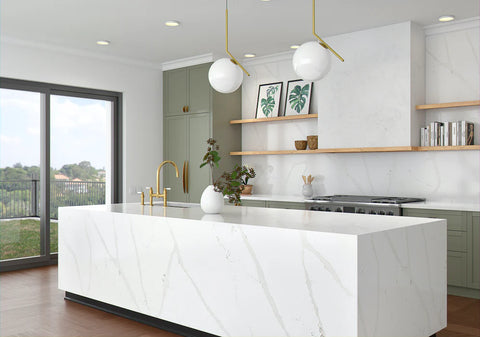
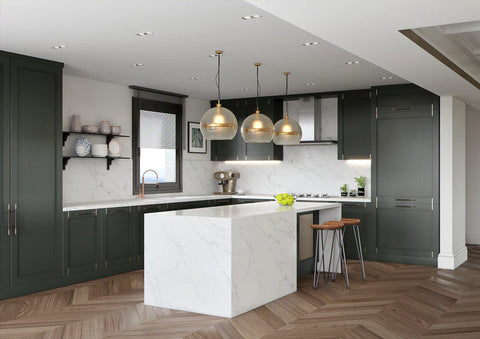
There is a fabrication difference between the two materials: in quartz, the colour runs through the full thickness, so the edge can be profiled freely; in ceramic, the pattern is usually printed on the surface, and on many models the body of the slab is a different colour, which limits the edge profiles.
2. Matt and textured finishes, mainly in ceramic
Among ceramic worktops, 29 models have a matt finish, and many also come in a gloss version, priced separately. For example, Statuario Extra (Fondovalle) costs 215,35 €/ml + VAT in gloss and 256,50 €/ml + VAT in matt.
In quartz, the range remains mostly glossy: 203 of 210 models. Matt textures are few, for example the Stone Italiana Grain and Rocface finishes on Superwhite 13 Grain, Superwhite 13 Rocface or Imperiale Rocface.
A maintenance point: fine scratches show more easily on glossy, dark quartz surfaces, so a chopping board is still recommended. The differences between the two finishes in ceramic are explained in the article on matt or gloss ceramic.
3. Stone, travertine, concrete and wood
Besides marble, sintered ceramic covers other looks too: 11 models have a stone look, 3 a travertine look, 3 a concrete look and 2 a wood look. Examples from the catalogue: Travertino Ebur, Chianca and Jura White (Fondovalle, Stone Lab collection), Ceppo di Gre (Nuovocorso), with a concrete look, and Komi Original and Komi Elegant (Fondovalle), with a wood look.
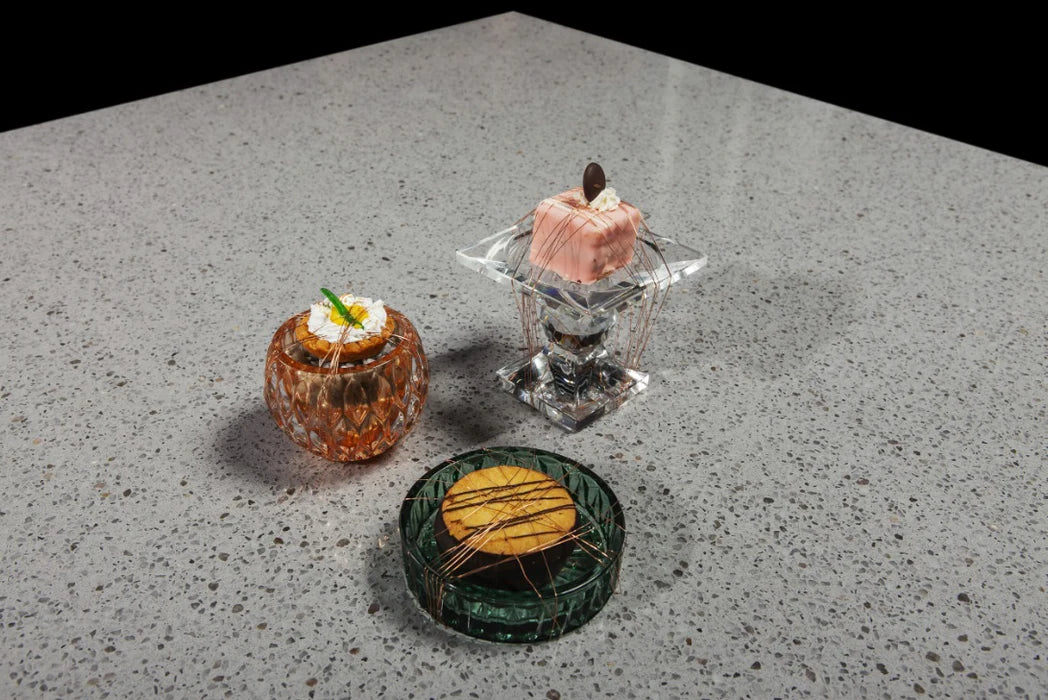
In quartz, these looks are rare: the catalogue has 2 models with a travertine look, 2 models with a concrete look and 1 model with a wood look. The usual alternatives to marble here are plain, speckled or granular shades, models with mirror inserts and the terrazzo look (Terrazzo White and Terrazzo Dark, Stone Italiana). For a stone or wood texture, ceramic offers more options.
4. Colours: white dominates, veined black adds contrast
White remains the widest choice: in quartz, 104 models have a white background, 32 a beige or cream background, 42 grey and 21 black. Strong colours remain rare: only 3 models have a green background.
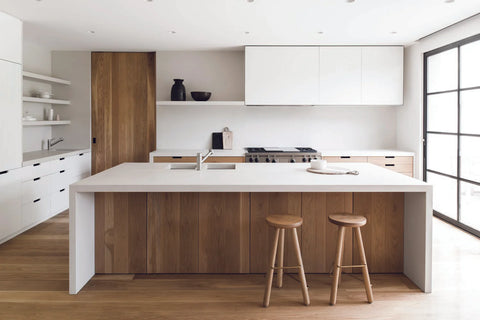
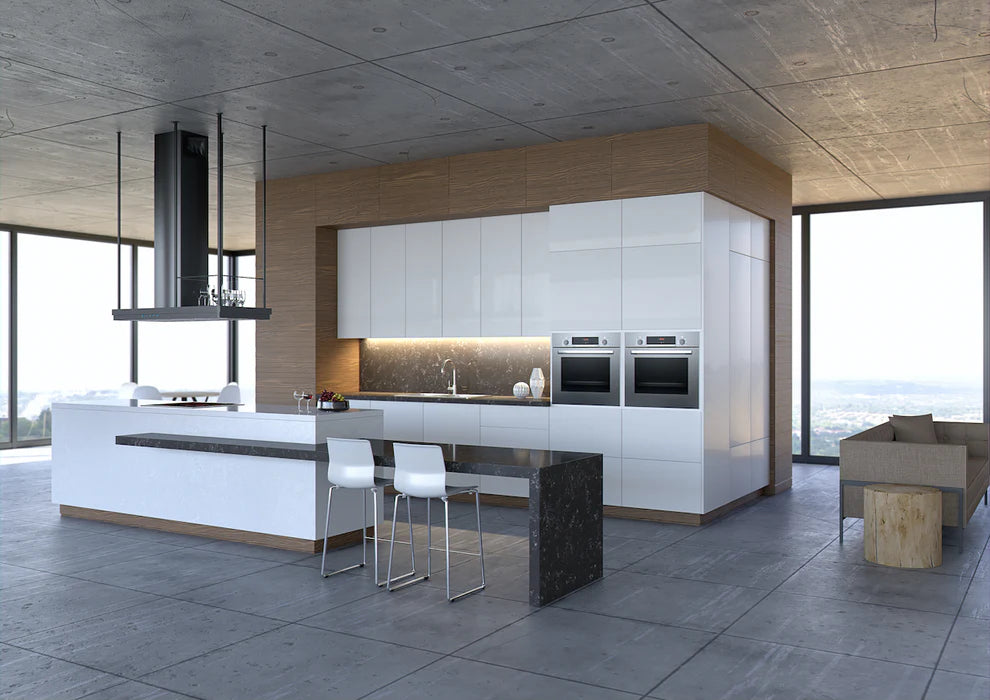
White and grey combinations remain easy to put into practice: a grey worktop on white units, or a white worktop on grey fronts. Two projects recently added to the portfolio show other options: white quartz with fine veining next to matt cappuccino fronts, and black Marquina-style quartz with white veining next to white fluted fronts.
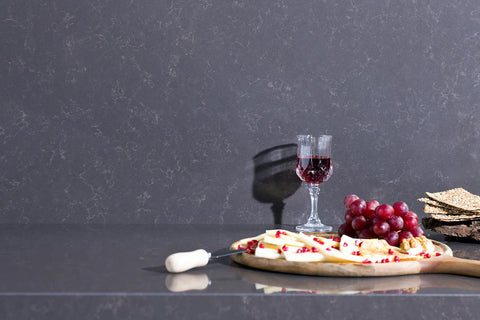
On white and cream worktops, stains show more easily if they are not cleaned in time. Traces of liquids and food should be wiped off while fresh: left for more than 24 hours, they can be hard to remove completely.
5. The same material on the wall, the island and the sink
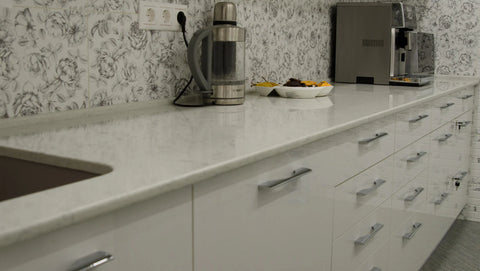
Wall cladding in the worktop material appears in many portfolio projects. In ceramic, large-format slabs, from 320 × 160 cm to 324 × 163 cm in the catalogue, allow surfaces with few joints; on the Calacatta White project in Bucharest, the veining of the wall panel continues onto the worktop and its edge. In quartz, the same effect is achieved with full-height cladding, island legs and sinks joined seamlessly to the worktop. Concrete examples are in the article with kitchen ideas with a quartz worktop.
6. Thin slabs, thick edges
The ceramic worktops in the catalogue are 1.2 cm thick, and in quartz 19 models are available in 1.5 cm slabs, which usually cost less than 2 cm ones. Thick edges are also chosen for islands, as in the portfolio projects with 6 or 10 cm edges. In quartz, the edge can be made to look thicker by joining a strip of the same material, usually to 3, 4 or 6 cm; in ceramic, to 2.4 or 4 cm, or as a vertical apron.
7. Outdoor kitchens
Sintered ceramic is the choice for summer kitchens and terraces: it contains no resins, is UV-stable and withstands heat. Composite quartz is not recommended outdoors, because direct and prolonged sunlight can discolour the resins. Suitable models are in the sintered ceramic worktops category, from 206,25 €/ml + VAT.
8. Quartz-free materials
Besides quartz and ceramic, the catalogue also includes Cosmolite, a Stone Italiana material that contains no quartz and, according to the manufacturer, is made from recycled minerals bound with resin (5 models, from 243,75 €/ml + VAT). Such materials are discussed because of the health of the people who process the slabs: dry cutting of quartz-containing materials produces crystalline silica dust, which can cause silicosis. An installed worktop gives off no dust, and in the Prowest workshop cutting and polishing are done with water.
In short: the trends by material
| Trend | Composite quartz | Sintered ceramic |
|---|---|---|
| Marble look | Quartz: the most widespread look in the catalogue; edge can be profiled freely. | Ceramic: faithful marble reproductions in large-format slabs; limited edge profiles. |
| Matt or textured finish | Quartz: few models (Grain, Rocface); most are glossy. | Ceramic: matt on many models, often also available in gloss. |
| Stone, travertine, concrete, wood | Quartz: a few models; terrazzo, plain, speckled or granular are more common. | Ceramic: all four looks, in the catalogue. |
| Wall cladding | Quartz: cladding, island legs, seamless sinks. | Ceramic: large-format slabs, with the pattern continued onto the worktop. |
| Outdoors | Quartz: not recommended. | Ceramic: suitable, UV-stable. |
| Starting price | Quartz: from 157,50 €/ml + VAT. | Ceramic: from 206,25 €/ml + VAT. |
Prices as listed on prowest.ro in October 2026, excluding VAT (€/ml = euro per linear metre). All quartz models are in the quartz kitchen worktops category.
What holds regardless of trends
The look is chosen by taste, but the material's behaviour should match the way you cook. Quartz does not tolerate hot pans placed directly on it and is not recommended in the sun; ceramic withstands heat and UV, but its edges are more sensitive to knocks. The full comparison, on ten criteria, is in the article quartz or ceramic.
Frequently asked questions
Is a white worktop still in fashion in 2026?
Yes. White is the widest choice in the catalogue: 104 of the 210 models in quartz have a white background, plain or veined. It goes with most front colours and makes the kitchen look brighter. The condition is that stains are cleaned while fresh.
Which worktop suits a summer kitchen?
A sintered ceramic worktop, including Neolith or Laminam. It contains no resins, so it does not fade in the sun and it withstands heat. Composite quartz is intended for indoor spaces.
Is a 1.2 cm ceramic worktop strong enough?
Yes, for normal use. The surface is highly resistant to scratches and heat, but the edges and corners are more sensitive to knocks than on quartz. If you want a thicker edge, it can be built up visually by joining.
You can see the materials in the Prowest showrooms in Bucharest: Str. Doina nr. 9, sector 5, and Expo Top Construct, Valea Cascadelor nr. 23, stand B4–B5. For a recommendation for your project, contact us.