Types of kitchen worktops: 9 materials at a glance
Published on 14 July 2020 · Updated on 31 October 2026
According to Prowest's specialists, kitchen worktops are made mainly from nine types of material: melamine-faced chipboard or HPL, solid wood, stainless steel, granite, marble, acrylic solid surface, engineered quartz, sintered ceramic (including Neolith and Laminam) and Cosmolite. They differ in how they cope with heat, water and stains, in maintenance and in price. Prowest makes worktops to order from the last three; the others are covered here for comparison.
The 9 materials in one table
| Material | Strength | Weakness | At Prowest |
|---|---|---|---|
| Melamine-faced chipboard or HPL | Strength: low price, many decors, simple installation. | Weakness: water getting in at joints and cut-outs swells the core; burns cannot be repaired. | At Prowest: no. |
| Solid wood | Strength: warm look; can be sanded and re-oiled. | Weakness: needs regular oiling or varnishing; marks from water, heat and knocks. | At Prowest: no. |
| Stainless steel | Strength: hygienic, resistant to water and heat. | Weakness: scratches visibly, shows fingerprints, can dent under impact. | At Prowest: no. |
| Granite | Strength: natural stone, resistant to heat and scratches. | Weakness: porous; periodic sealing is usually recommended. | At Prowest: no. |
| Marble (and travertine) | Strength: natural, unrepeatable pattern; can be re-polished. | Weakness: soft and sensitive to acids (lemon, vinegar, wine); stains. | At Prowest: no. |
| Acrylic composite (solid surface) | Strength: virtually invisible joints, curved shapes, integrated sink. | Weakness: scratches more easily; does not tolerate hot pans. | At Prowest: no. |
| Engineered quartz | Strength: non-porous, many shades and edge profiles, edges more tolerant of knocks. | Weakness: does not tolerate hot pans; not recommended outdoors. | At Prowest: yes. |
| Sintered ceramic (Neolith, Laminam) | Strength: resistant to heat, sunlight and scratches; non-porous. | Weakness: edges and corners are sensitive to knocks; limited edge profiles. | At Prowest: yes. |
| Cosmolite | Strength: non-porous, no quartz in its composition. | Weakness: contains resin, so it calls for care with heat; few models in the catalogue. | At Prowest: yes. |
Melamine-faced chipboard, HPL and solid wood
Melamine-faced chipboard is a board of pressed wood particles covered with a decorative melamine layer. On HPL (high-pressure laminate) worktops the surface layer is thicker and resists scratches and heat better, but the core is usually still chipboard or MDF. The weak point of both is water: if it gets in at the joints, along the edge or around the cut-outs, the core swells irreversibly. Burns and chips in the surface layer cannot be repaired.
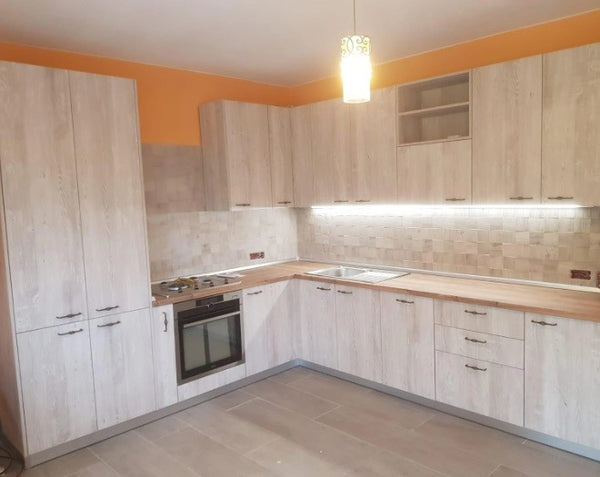
Solid wood (oak, beech) has a warm look and can be sanded down when it wears, but it needs regular oiling or varnishing and is marked by standing water, knocks and heat.
Stainless steel
Stainless steel, the material of professional kitchens, absorbs nothing, resists water and heat and allows sinks welded into the worktop. However, it scratches from the first days of use, shows fingerprints and can dent under heavy impact.
Granite and marble: natural stone
Granite
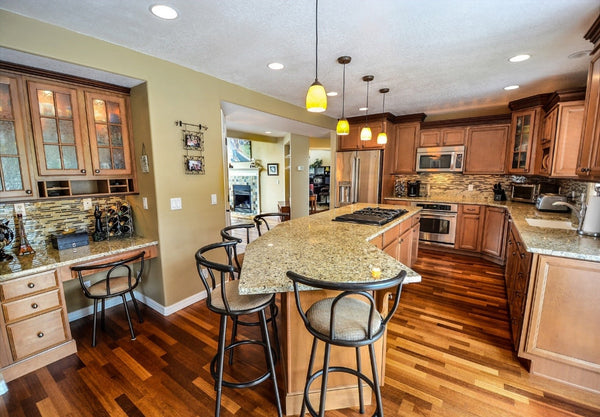
Granite is a natural rock made mainly of quartz, feldspar and mica. It resists heat and scratches well, and every slab is unique. It is porous, however, to a degree that varies from one stone to another, so periodic sealing is usually recommended; otherwise oil or wine can leave stains. A broken piece is hard to replace with an identical one. Prowest does not work with natural granite. Watch the names: engineered quartz is sometimes sold as "composite granite", although it contains no granite.
Marble and travertine
Marble is a calcareous rock, much softer than granite: the calcite it is made of has a hardness of 3 on the Mohs scale. Kitchen acids (lemon, vinegar, wine) leave dull marks on it, and its pores absorb liquids if the surface is not sealed; but a superficial scratch can be polished out. Travertine, also calcareous and with natural voids in its structure, has the same sensitivities.
Acrylic composite (solid surface)
Acrylic composites, known by brands such as Corian, Hi-Macs or Kerrock, are made of acrylic resin and mineral fillers. The pieces are bonded with virtually invisible joints, can be heat-formed into curves and allow integrated sinks in the same material. However, they scratch and dull more easily than stone and do not tolerate hot pans; superficial scratches can be sanded out.
Engineered quartz
Engineered (composite) quartz is a manufactured material, not a natural stone: ground natural quartz, usually more than 90% by weight, bound with polyester resins and coloured with pigments. The resin makes the surface non-porous, with no need for sealing, but it is also what makes it sensitive to heat and sunlight: it only tolerates brief exposure to temperatures of up to 100–120 °C and is not recommended outdoors.
Quartz crystals have a hardness of 7 on the Mohs scale: good scratch resistance, not immunity (diamond is 10, and the scale is not linear). Because the material is coloured through its full thickness, quartz allows more edge profiles; it also tolerates knocks on the edges better than ceramic.
Among the kitchen worktops in the Prowest catalogue, quartz has the most models, 210 in total, from Belenco, Calisco, Cimstone, Stone Italiana and Technistone. Brands and ranges are compared in the guide to choosing the best quartz worktop.
Sintered ceramic, Neolith and Laminam
Sintered ceramic (also called porcelain or sintered stone) is produced in large-format slabs from natural minerals pressed and fired at over 1,200 °C, without resins. That is why it resists heat and UV rays, can also be used in outdoor kitchens and does not absorb liquids. Its weak point is the edges and corners: a knock from a heavy object can chip the edge, and the chip is hard to repair without a trace. On many models the pattern is printed on the surface and the body is a different colour, which limits the edge profiles.
Neolith (the brand of the Spanish manufacturer TheSize) and Laminam (an Italian manufacturer) belong to the same family of sintered slabs. The Prowest catalogue lists 46 models of ceramic kitchen worktops, 64 models from Neolith and 59 models from Laminam. For ceramic and Neolith, the thickness stated in the catalogue is 1.2 cm; for Laminam, the catalogue includes 1.2 cm and 2 cm slabs.
Cosmolite
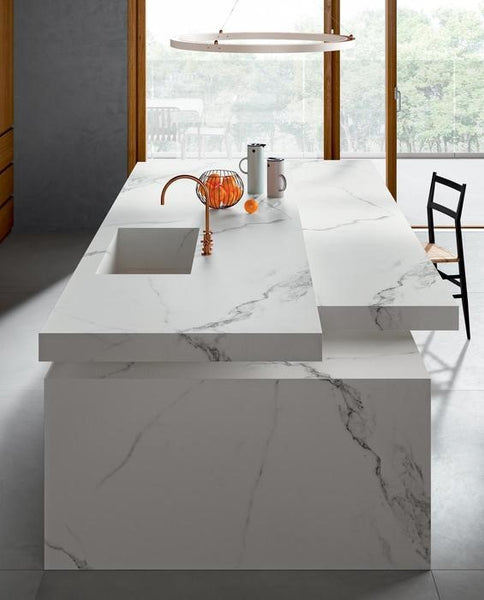
Cosmolite is a worktop material developed by Stone Italiana which, unlike engineered quartz, contains no quartz; according to the manufacturer, it is made from recycled minerals bound with resin. The surface is non-porous. Because Cosmolite also contains resin, treat it with the same care as quartz where heat is concerned. The catalogue includes 5 models of Cosmolite kitchen worktops.
Prowest prices by material
| Material | Models in the catalogue | From (€/lm + VAT) | Median price (€/lm + VAT) |
|---|---|---|---|
| Engineered quartz | Models: 210 models | From: 157,50 €/lm + VAT (1.019 lei/lm incl. VAT) | Median: 237,55 €/lm + VAT (1.537 lei/lm incl. VAT) |
| Sintered ceramic | Models: 46 models | From: 206,25 €/lm + VAT (1.334 lei/lm incl. VAT) | Median: 250,80 €/lm + VAT (1.622 lei/lm incl. VAT) |
| Neolith | Models: 64 models | From: 325,60 €/lm + VAT (2.106 lei/lm incl. VAT) | Median: 445,50 €/lm + VAT (2.882 lei/lm incl. VAT) |
| Laminam | Models: 59 models | From: 286 €/lm + VAT (1.850 lei/lm incl. VAT) | Median: 334,80 €/lm + VAT (2.166 lei/lm incl. VAT) |
| Cosmolite | Models: 5 models | From: 243,75 €/lm + VAT (1.577 lei/lm incl. VAT) | Median: 262,50 €/lm + VAT (1.698 lei/lm incl. VAT) |
Prices per linear metre, excluding VAT, as shown on prowest.ro in November 2026; they may include current promotions. Special edge profiles, cut-outs, delivery and installation are calculated in the quote.
How to choose the material
- Tight budget or a temporary kitchen: melamine-faced chipboard or HPL, with the joints and cut-outs well sealed.
- You cook a lot, with pans straight off the hob: sintered ceramic, Neolith or Laminam.
- Outdoor kitchen or a worktop in strong sunlight: sintered ceramic; quartz and acrylic composites are not recommended.
- A wide range of shades and more forgiving edges: engineered quartz.
- Natural stone with an unrepeatable pattern: granite or marble, with periodic sealing.
For the stone-type materials, ten criteria are compared in the comparison of quartz, ceramic, Neolith, Laminam and granite.
Prices in lei include 21% VAT, at the NBR exchange rate of 11.11.2026 (€1 = 5,3460 lei).
Frequently asked questions
What is the most durable material for a kitchen worktop?
It depends on the kind of use. For heat and sunlight, sintered ceramic, granite and stainless steel perform best. For stains, the safest are the non-porous materials: quartz, ceramic and stainless steel. For knocks on the edges, quartz is more forgiving than ceramic. No material wins on every criterion, so the choice starts with the way you cook.
What is the cheapest type of kitchen worktop?
Melamine-faced chipboard, followed by HPL. Among the materials Prowest works with, quartz starts from 157,50 €/lm + VAT (1.019 lei/lm incl. VAT) and sintered ceramic from 206,25 €/lm + VAT (1.334 lei/lm incl. VAT). When comparing, also consider how well the worktop stands up to water and wear, not just the price per metre.
Can a quartz or ceramic worktop be fitted on any kitchen units?
Yes. Prowest fits quartz and ceramic worktops on any units that are stable, level and fixed in their final position before the measurements, because the worktop rests on them across its whole surface. The pieces can weigh more than 100 kg and are handled by the installation team. If the units are moved or adjusted after installation, the worktop can come under stress and crack.
You can see the materials in person at the Prowest showrooms in Bucharest, at Str. Doina nr. 9 and at Expo Top Construct. For a recommendation for your kitchen, contact us.