Heat-resistant kitchen worktop: which material to choose
Published on 31 May 2024 · Updated on 31 October 2026
In short: of the worktops in the Prowest catalogue, sintered ceramic, Neolith and Laminam cope best with heat, because they contain no resins. Engineered quartz and Cosmolite contain resin, so hot pans should always go on a trivet. For quartz, the limit is brief exposure to no more than 100–120 °C, far below the temperature of a pan taken straight off the hob.
Why some worktops withstand heat and others do not
The difference lies in the binder, the material that holds the particles together. Ceramic slabs are made from natural minerals pressed and fired at over 1,200 °C; after firing, nothing organic is left that could soften or burn. In engineered quartz, the quartz crystals are bound with polyester resins, and in Cosmolite the recycled minerals are also bound with resin. Resin can discolour or soften at temperatures that a pan from the hob or a tray from the oven easily exceeds: a domestic oven usually bakes at 180–220 °C.
The second factor is thermal shock. When a hot object suddenly heats a small area, that area expands more than the rest of the slab, which is still cold, and the difference creates stresses in the material. The datasheets show why quartz is more exposed: Stone Italiana declares a thermal expansion coefficient of 17–26 × 10⁻⁶ per degree Celsius for its quartz (EN 14617-11), and Nuovocorso around 7 × 10⁻⁶ for its ceramic slabs (EN ISO 10545-8). For the same temperature difference, quartz expands roughly 2.4 to 3.7 times as much. The Fondovalle and Nuovocorso ceramic slabs are declared resistant to thermal shock according to EN ISO 10545-9.
How each material behaves with heat
| Material | Heat and hot pans | Sun and outdoor use | At Prowest |
|---|---|---|---|
| Sintered ceramic (porcelain) | Heat: no resins; it withstands heat, and manufacturers declare resistance to thermal shock. | Outdoors: UV-stable, also suitable for outdoor kitchens. | Catalogue: from 206,25 €/lm + VAT (1.334 lei/lm incl. VAT), 1.2 cm thick. |
| Neolith | Heat: sintered stone, no resins; it behaves like ceramic. | Outdoors: UV-stable, also suitable outdoors. | Catalogue: from 325,60 €/lm + VAT (2.106 lei/lm incl. VAT), 1.2 cm thick. |
| Laminam | Heat: sintered ceramic slabs, with no resins or organic binders. | Outdoors: UV-stable, also suitable outdoors. | Catalogue: from 286 €/lm + VAT (1.850 lei/lm incl. VAT), 1.2 and 2 cm slabs. |
| Engineered quartz | Heat: tolerates only brief exposure, up to 100–120 °C; hot pans go on a trivet. | Outdoors: not recommended; direct, prolonged sunlight can discolour the resin. | Catalogue: from 157,50 €/lm + VAT (1.019 lei/lm incl. VAT), 2 cm thick, 1.5 cm on some models. |
| Cosmolite | Heat: recycled minerals bound with resin; hot pans go on a trivet. | Outdoors: recommended for indoor use. | Catalogue: from 243,75 €/lm + VAT (1.577 lei/lm incl. VAT), 2 cm thick where stated. |
| Natural granite | Heat: withstands heat; like any stone, it can be affected by sudden temperature changes. | Outdoors: also used outdoors. | Catalogue: not in the Prowest catalogue. |
| Melamine-faced chipboard or HPL | Heat: the decorative layer can discolour or deform under a hot pan, and the chipboard core swells with steam and water. | Outdoors: not suitable. | Catalogue: not in the Prowest catalogue. |
| Acrylic composite (solid surface) | Heat: based on an acrylic resin; it is sensitive to heat and needs a trivet. | Outdoors: usually for indoor use only. | Catalogue: not in the Prowest catalogue. |
Prices are per linear metre, excluding VAT, as shown on prowest.ro in November 2026, and may include current promotions.
Ceramic, Neolith and Laminam: what you gain and what to avoid
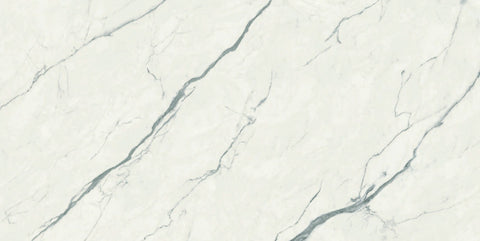
For anyone who cooks a lot, the advantage of ceramic is simple: the surface has no resin to burn or discolour. Fondovalle states that the porcelain stoneware of its MyTop slabs is unaffected by high temperatures, and in the dry heat resistance test (EN 12722) it gives them a rating of 5: no visible effect up to 200 °C. The same slabs are UV-stable, so they can also be used on a terrace or in an outdoor kitchen.
The limits are mechanical, not thermal. The slabs are usually 1.2 cm thick, and the edges and corners are more sensitive to impact than on quartz: a heavy cast-iron pan dropped on the edge can chip it, and a chip is hard to repair invisibly. A trivet is still useful on ceramic, but for a different reason: the metal base of some pans, dragged across the worktop, can leave metal marks on the surface.
The Prowest catalogue includes ceramic kitchen worktops (46 models, median price 250,80 €/lm + VAT, i.e. 1.622 lei/lm incl. VAT), Laminam worktops (median 334,80 €/lm + VAT, i.e. 2.166 lei/lm incl. VAT) and Neolith worktops (median 445,50 €/lm + VAT, i.e. 2.882 lei/lm incl. VAT). All three behave similarly with heat; the differences are in the designs, finishes and price.
Quartz and Cosmolite: simple rules near the hob
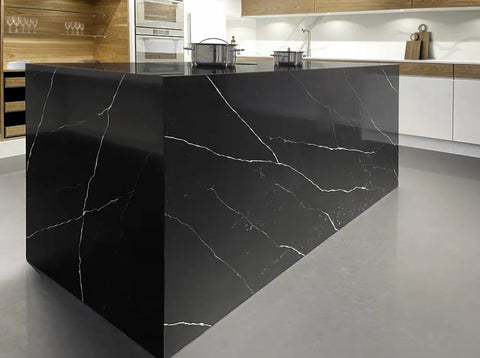
Engineered quartz has the widest choice in the catalogue (210 models of kitchen worktops), and heat is not a problem if you follow a few rules. A hot pot, pan or tray is far above the 100–120 °C limit, so if it is put directly on the worktop it can leave a discoloured patch, dull the surface or crack the slab through thermal shock.
- put pans taken off the hob or out of the oven on a heat-resistant trivet or on a cold zone of the hob;
- do not slide a pan from the hob straight onto the worktop;
- appliances that heat the same spot for a long time, such as an electric grill, a slow cooker or a portable hob, should stand on an insulating mat;
- do not leave a tray taken out of the oven on the corner of the worktop next to the oven, even briefly.
The same rules apply to Cosmolite: although Stone Italiana declares good heat resistance for it, the binder is still a resin, and the Cosmolite product pages in the Prowest catalogue call for a trivet, because thermal shock can affect the surface.
The worktop next to the hob and oven: what to settle at the design stage
Most heat-related problems occur around the hob, so they are worth discussing at the measuring visit, when the positions of the cut-outs are agreed.
- Cut-out corners. The manufacturers' fabrication instructions call for rounded corners, never 90°: Stone Italiana for quartz and, for ceramic, EKXTRA with a radius of at least 5 mm. A sharp corner concentrates stresses, including those caused by heat.
- Distance to the edge. For its MyTop slabs, Fondovalle requires at least 2 inches, about 5 cm, between the cut-out and the outer edge. A very narrow strip in front of or behind the hob is the most fragile part of the worktop.
- Type of hob. An induction hob heats the pan, not the glass: the glass zone is warmed by the pan and stays hot after cooking, but the surrounding worktop receives no direct heat. With a gas hob, follow the clearances in the appliance instructions, and large pans should not overhang the edge of the hob towards the worktop.
- Flush-mounted hob. This can also be done on quartz; Prowest has made such a cut-out in a kitchen with a black quartz worktop and wall cladding. Flush mounting is decided before fabrication, because a rebate is milled around the cut-out to take the edge of the hob.
- Built-in oven. Whether under the worktop or in a tall unit, the oven is installed with the ventilation gaps required by the appliance manufacturer; the worktop must not cover the vents.
Prices in lei include 21% VAT, at the NBR exchange rate of 11.11.2026 (€1 = 5,3460 lei).
Frequently asked questions
Can I put a hot pot directly on a ceramic worktop?
Sintered ceramic, from which Prowest makes kitchen worktops, contains no resins, and manufacturers declare the slabs resistant to heat and thermal shock, so a hot pan will not burn the surface. A trivet is still a sensible precaution for heavy cast-iron pans, which can strike the edge, and for metal bases, which can leave marks.
What happens if I put a hot pan on a quartz worktop?
A discoloured patch, loss of gloss or a crack caused by thermal shock can appear. Such marks are hard to repair, which is why hot pans should always go on a trivet on quartz and Cosmolite. The Prowest commercial warranty requires the care and use instructions to be followed and does not affect the consumer's statutory rights regarding product conformity (Romanian Government Emergency Ordinance no. 140/2021).
Which worktop should I choose for an outdoor kitchen?
Sintered ceramic, Neolith or Laminam. They are UV-stable and cope with temperature changes, and the Fondovalle and Nuovocorso datasheets declare the ceramic slabs frost-resistant. Engineered quartz and Cosmolite are intended for indoor use.
Quartz or ceramic, if I cook a lot?
If you want to be able to leave pans on the worktop without worrying, Prowest recommends ceramic, the safer choice for heat. Quartz is more resistant to knocks on the edges and allows more edge profiles. All the criteria, from stains to price, are in the comparison quartz or ceramic: which worktop to choose.
If you are not sure which material suits the way you cook, see the materials in the Prowest showrooms in Bucharest or send us a sketch of your kitchen through the contact page.